




Maison Margiela: The Art of Reinvention, Deconstruction and Quiet Luxury!
In the world of fashion, where logos, celebrity endorsements and seasonal trends often dominate attention, Maison Margiela has always followed a different path. The French fashion house built its identity around anonymity, experimentation, deconstruction and the idea that clothing can be much more than something worn on the body. It can be an intellectual statement, a social commentary and a work of art.
Founded in Paris in 1988 by Belgian designer Martin Margiela, the house challenged almost every conventional rule of luxury fashion. From garments turned inside out to unfinished hems, oversized silhouettes and recycled materials, Margiela transformed imperfections into design features. The brand’s approach was deliberately unconventional, encouraging people to look beyond labels and question what fashion is supposed to be.
Today, Maison Margiela remains one of the most influential names in contemporary fashion. Its signature codes continue to inspire designers, artists and fashion enthusiasts around the world, while its fragrances have introduced the house’s creative philosophy to an even wider audience.
The Beginning of Maison Margiela
Maison Margiela was established in Paris in 1988 by Martin Margiela, a designer who had already gained valuable experience working with Jean Paul Gaultier. From the beginning, Margiela approached fashion differently from the established luxury houses of the time.
While many designers were building recognizable personal brands, Margiela preferred to remain anonymous. His name rarely appeared prominently, and he avoided the traditional celebrity-driven image associated with fashion designers. The focus was intended to remain on the clothing rather than the personality of the person who created it.
This philosophy became one of the most distinctive characteristics of the house.
Margiela’s debut collections challenged traditional ideas of beauty and luxury. Instead of presenting perfectly polished garments, he experimented with unconventional proportions, second-hand clothing, recycled fabrics and exposed construction. He demonstrated that something considered imperfect or ordinary could become extraordinary when viewed from a different perspective.
The Philosophy of Deconstruction
Deconstruction became one of Maison Margiela’s most important creative principles.
Traditional tailoring generally attempts to hide the construction of a garment. Seams are concealed, linings are neatly finished and imperfections are corrected. Margiela reversed this approach.
He exposed seams, highlighted unfinished edges and sometimes presented the internal structure of clothing as an external design element. The process of making a garment became part of the garment itself.
This approach transformed the way people thought about fashion.
A jacket was no longer simply a jacket. Its lining, stitching, shoulder construction and pattern could all become visible parts of the design. By revealing these elements, Margiela encouraged viewers to appreciate the craftsmanship behind clothing.
Deconstruction also gave the house a distinctive visual language—one that could be recognized without relying on a traditional logo.

The Iconic Four Stitches
One of Maison Margiela’s most recognizable signatures is its four white stitches.
They first appeared on the back of garments as a subtle alternative to a conventional logo. Rather than placing a prominent brand name on the front of a garment, the house used four simple stitches to identify its creations.
The detail became so recognizable that it eventually developed into a symbol of Maison Margiela itself.
The four stitches represent the house’s broader philosophy: branding can be understated, mysterious and intellectual. They invite those familiar with the brand to recognize it without requiring an obvious display of status.
This subtle approach has become especially relevant in an era when many consumers are increasingly interested in understated luxury.
The Numbered Labels
Another distinctive feature of Maison Margiela is its numbered label system.
The garments traditionally feature a plain white label with a series of numbers, with specific numbers corresponding to different categories of products. The label reinforces the house’s rejection of conventional branding.
Instead of a large logo or designer signature, the numbered label creates a sense of mystery.
For fashion enthusiasts, these details have become part of the pleasure of discovering Maison Margiela. The brand does not always announce itself immediately. Its identity is hidden in construction, details and codes that reward a closer look.
Tabi: The Shoe That Became an Icon
Perhaps no Maison Margiela creation is more recognizable than the Tabi shoe.
Inspired by the traditional Japanese tabi sock, which separates the big toe from the other toes, the Tabi was introduced by Martin Margiela in 1988. Its split-toe shape immediately challenged conventional ideas of footwear design.
At first glance, the silhouette can appear unusual. Yet that unconventional quality is precisely what made it memorable.
Over the decades, the Tabi has appeared in numerous versions, including boots, pumps, sandals and flats. Its distinctive shape has become one of the most enduring symbols of the house.
The Tabi represents everything Maison Margiela stands for: historical reference, cultural inspiration, experimentation and a willingness to create something that does not immediately conform to conventional ideas of beauty.
Artisanal Collections
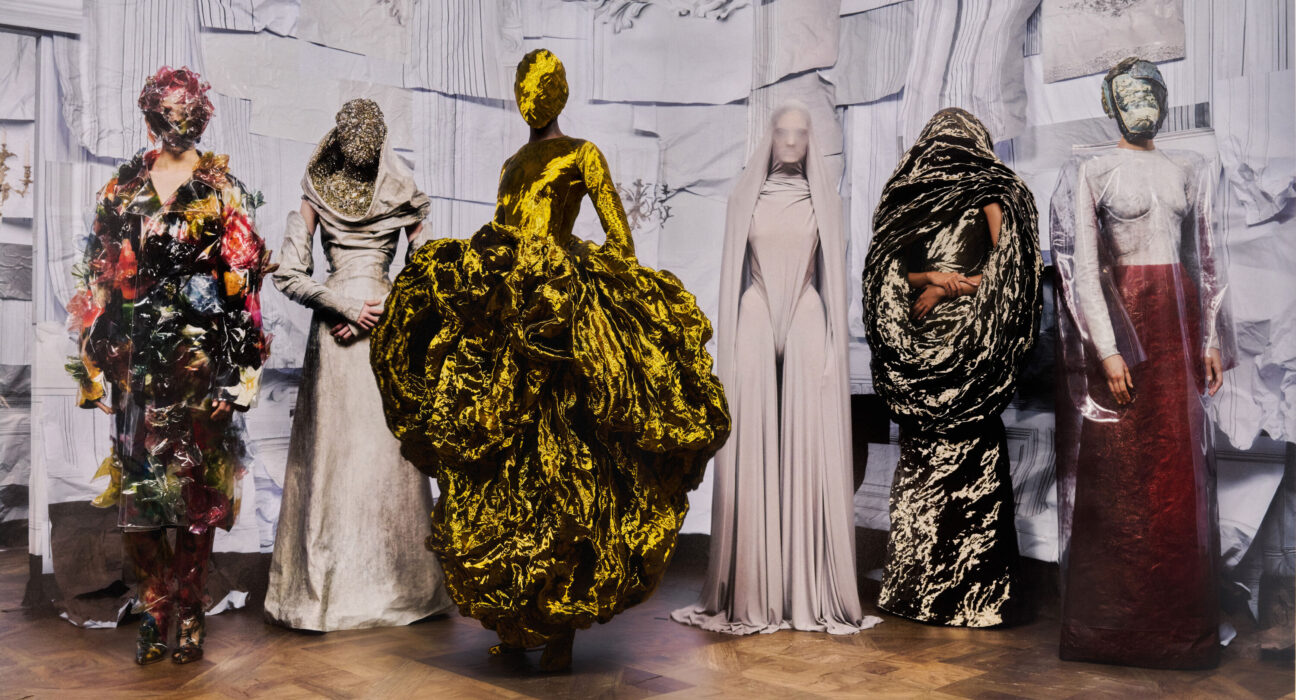
Maison Margiela’s Artisanal collections represent another important part of the house’s identity.
These collections are known for their extraordinary craftsmanship, experimental techniques and transformation of existing materials. Vintage garments, household objects and discarded materials can be reimagined into highly detailed fashion pieces.
The process often blurs the boundaries between fashion and art.
A garment may appear to have been constructed from unexpected objects or materials, yet the craftsmanship behind it can be extraordinarily complex. This creates a fascinating contrast between the ordinary source material and the luxurious final result.
Artisanal fashion also reflects the house’s long-standing interest in recycling and transformation. Rather than treating old materials as useless, Margiela’s approach demonstrates how they can acquire a new identity.
Maison Margiela and the Art of Anonymity
Martin Margiela’s decision to remain largely out of the public eye was revolutionary.
Fashion has traditionally been heavily connected to designers’ personalities. Names such as Coco Chanel, Christian Dior and Yves Saint Laurent became inseparable from the houses they created.
Margiela took the opposite route.
He rarely gave interviews and avoided traditional publicity. His absence created an unusual mystery around the brand.
This anonymity also raised an important question: can a fashion house become famous without turning its designer into a celebrity?
Maison Margiela demonstrated that it could.
The clothes, rather than the designer, became the central character.
The Evolution of the House
After Martin Margiela stepped away from the house in the late 2000s, Maison Margiela continued to evolve while maintaining many of its foundational ideas.
One of the most significant developments came with the appointment of John Galliano as creative director in 2014.
Galliano brought his own dramatic, theatrical and highly expressive design language to the house. His work expanded Maison Margiela’s creative vocabulary while continuing to explore transformation and unconventional construction.
Under Galliano, the house gained renewed attention for spectacular runway presentations and experimental couture.
His collections demonstrated that Maison Margiela’s original philosophy could continue evolving rather than simply being preserved as fashion history.
Maison Margiela Fragrances
The house’s influence extends beyond clothing into fragrance.
Maison Margiela’s fragrance collection includes the popular Replica line, which is built around the idea of recreating memories and familiar moments through scent.
Instead of naming fragrances only after traditional ingredients or abstract concepts, Replica fragrances often evoke specific experiences and environments.
The concept is powerful because fragrance is closely connected to memory.
A particular scent can remind someone of a holiday, a rainy afternoon, freshly washed clothes, a café or a summer evening. Maison Margiela’s Replica collection turns this emotional connection into the foundation of its fragrance storytelling.
Among its best-known fragrances is Replica By the Fireplace, which combines smoky, woody and sweet elements to evoke the atmosphere of sitting beside a warm fireplace.
Another recognizable fragrance is Lazy Sunday Morning, designed around the comforting idea of clean sheets and a relaxed morning.
These fragrances demonstrate the house’s ability to transform ordinary experiences into luxury products.

Replica and the Power of Memory
The Replica concept is particularly interesting because it changes the way consumers think about fragrance.
Rather than asking only, “What does this perfume smell like?”, Replica encourages another question: “What does this perfume make me remember?”
That emotional approach has helped the collection become distinctive in the crowded fragrance market.
The minimalist packaging also reflects Maison Margiela’s design philosophy. Instead of relying on flashy branding, the bottles use simple labels inspired by archival references.
The result is a fragrance collection that feels connected to the larger identity of the fashion house.
Maison Margiela’s Influence on Modern Fashion
Maison Margiela’s influence can be seen across contemporary fashion.
The house helped popularize ideas that were once considered unconventional: oversized proportions, exposed construction, repurposed clothing, unfinished edges and anonymous branding.
Many modern designers have explored similar ideas, although each has interpreted them differently.
Margiela also contributed to a broader cultural shift in how consumers view luxury.
Luxury does not necessarily have to mean gold hardware, visible logos or traditional elegance. It can also mean craftsmanship, originality, intellectual design and scarcity.
This is one reason Maison Margiela continues to appeal to people interested in fashion beyond conventional status symbols.
Quiet Luxury Before It Became a Trend
The current interest in quiet luxury has brought renewed attention to brands that emphasize subtle design rather than prominent logos.
Maison Margiela fits naturally into this conversation, although its approach is more experimental than traditional quiet luxury.
The house’s understated labels, four stitches and distinctive construction allow knowledgeable consumers to recognize the product without requiring obvious branding.
However, Maison Margiela is not simply a minimalist brand.
Its designs can be dramatic, sculptural and unconventional. The quietness comes primarily from its approach to branding, not necessarily from the clothes themselves.
Sustainability and Reinterpretation
Maison Margiela’s use of recycled and transformed materials has also become increasingly relevant in discussions surrounding fashion sustainability.
Long before sustainability became one of the industry’s most important conversations, Margiela was experimenting with existing garments and materials.
The concept of transformation is central to this approach.
An old garment can become something new. A familiar object can acquire another purpose. A traditional silhouette can be reconstructed into an unexpected form.
This philosophy challenges the idea that luxury requires everything to be completely new.
At the same time, sustainability in fashion is a complex issue, and individual collections or products should not automatically be considered sustainable simply because they use recycled or repurposed materials. The broader environmental impact of production, transportation and consumption remains important.
The Maison Margiela Customer
The Maison Margiela customer is often attracted to individuality rather than conventional fashion status.
The appeal may come from the unusual shape of a Tabi boot, the subtle four-stitch detail, an experimental garment or the emotional storytelling of a Replica fragrance.
The house appeals particularly strongly to consumers who enjoy discovering details.
There is an intellectual quality to the brand. Wearing Maison Margiela can feel less like displaying a recognizable luxury logo and more like participating in a fashion conversation.
Why Maison Margiela Remains Relevant
Fashion changes constantly, but Maison Margiela has remained relevant because its foundation is not based entirely on trends.
Its central questions are broader:
What makes something beautiful?
What makes something luxurious?
Why should construction be hidden?
Why must a designer’s identity be visible?
Can an old object become more valuable through transformation?
These questions continue to be relevant.
Rather than simply creating seasonal clothing, Maison Margiela has contributed to a different way of thinking about fashion.
Maison Margiela Today
Today, Maison Margiela operates as a globally recognized luxury fashion house while maintaining the experimental spirit associated with its origins.
Its collections span ready-to-wear, accessories, footwear, couture and fragrance.
The brand’s signature elements remain immediately recognizable: the four stitches, numbered labels, Tabi silhouette, deconstructed construction and interest in transformation.
Yet the house continues to evolve.
That ability to change while maintaining a recognizable identity is one of the most interesting aspects of Maison Margiela.

Conclusion
Maison Margiela is more than a fashion label. It represents a philosophy of questioning conventions.
From its earliest collections, the house challenged the idea that fashion needed to be polished, predictable or heavily branded. Martin Margiela introduced a new visual language based on deconstruction, anonymity and transformation, and those ideas continue to influence fashion decades later.
The Tabi shoe became an icon because it refused to look like conventional footwear. The four stitches became a recognizable signature because they avoided the traditional approach to branding. The Artisanal collections demonstrated how discarded materials could become objects of extraordinary craftsmanship. And the Replica fragrance collection showed how everyday memories could become the foundation for luxury scent.
Maison Margiela’s enduring appeal ultimately comes from its ability to make people look twice.
A visible seam becomes a design element. An old garment becomes a new creation. A simple stitch becomes a brand signature. A familiar smell becomes a memory.
In a fashion industry often driven by constant novelty, Maison Margiela offers something different: the idea that innovation can come from looking at familiar things in unfamiliar ways.
That is perhaps the most lasting legacy of the house—not simply a particular silhouette or logo, but a way of seeing.
Maison Margiela reminds us that fashion does not always need to explain itself immediately. Sometimes, the most memorable designs are the ones that make us stop, look closer and ask questions.