




Alexander McQueen: The Visionary Who Redefined Fashion!
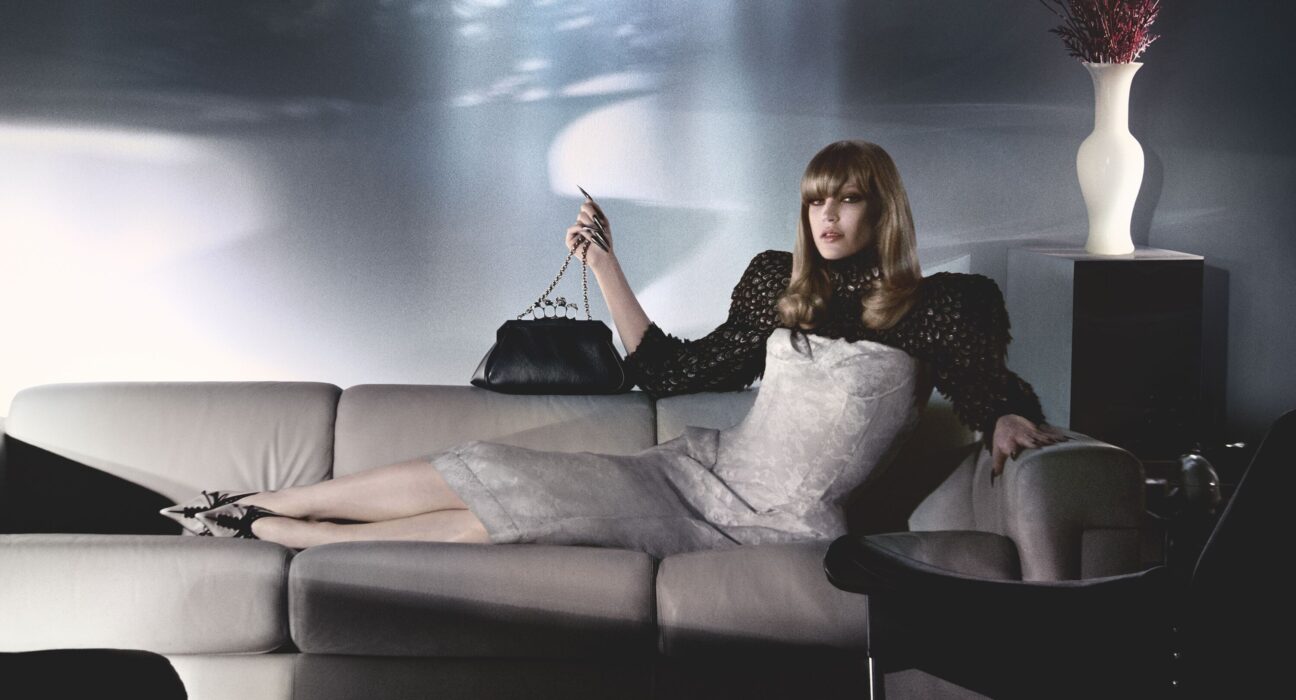
Alexander McQueen remains one of the most influential and unforgettable names in modern fashion. Known for his dramatic runway shows, extraordinary tailoring, dark romanticism, and emotionally powerful designs, McQueen transformed fashion into a form of storytelling. His work combined traditional British tailoring with rebellion, art, history, technology, and raw emotion. Even years after his death, his influence continues to shape contemporary fashion.
Born Lee Alexander McQueen on March 17, 1969, in London, he grew up in a working-class family and developed an early interest in clothing and craftsmanship. His journey from a young apprentice on London’s Savile Row to one of the world’s most celebrated fashion designers is a remarkable story of talent, determination, imagination, and creative fearlessness.
Early Life and the Beginning of His Fashion Journey
Alexander McQueen was the youngest of six children. His father, Ronald McQueen, worked as a taxi driver, while his mother, Joyce, was a social science teacher. From an early age, McQueen showed an interest in fashion and design. He reportedly began creating clothes for his sisters, demonstrating a natural understanding of clothing and construction.
At the age of 16, McQueen left school and began working as an apprentice at Anderson & Sheppard, one of London’s prestigious traditional tailoring houses on Savile Row. He later worked at Gieves & Hawkes, where he developed exceptional skills in classic tailoring.
These experiences became fundamental to his design identity. McQueen understood the structure of a garment at an extremely technical level. His knowledge of tailoring later allowed him to manipulate traditional silhouettes and transform them into something provocative and unexpected.
He also worked with theatrical costume makers Angels and Bermans, where he learned techniques associated with historical garments and costume construction. His desire to explore fashion beyond conventional boundaries eventually took him outside Britain.
McQueen briefly worked for Japanese designer Koji Yamamoto and later moved to Milan to work as an assistant to Italian designer Romeo Gigli. These international experiences broadened his perspective and helped him develop a unique approach to fashion.
Central Saint Martins and the Birth of a Designer
A major turning point came when McQueen enrolled at Central Saint Martins College of Art and Design in London. He completed a master’s degree in fashion design in 1992.
His graduation collection immediately attracted attention. The collection, titled “Jack the Ripper Stalks His Victims,” showcased many of the elements that would later define his career: historical references, sexuality, darkness, tailoring, theatricality, and storytelling.
The collection was purchased by influential fashion stylist Isabella Blow, who became one of McQueen’s most important supporters and friends. Blow recognized his extraordinary potential and reportedly bought the entire collection.
Her support played a significant role in launching McQueen’s career. She encouraged him to use his middle name professionally, leading to the name by which the fashion world would come to know him: Alexander McQueen.
Establishing His Own Fashion House
In 1992, McQueen founded his own fashion label. His early collections quickly established him as one of London’s most exciting new designers.
His work challenged conventional ideas of beauty. Instead of simply creating clothes designed to look attractive, McQueen wanted his collections to provoke reactions. His runway presentations often explored themes such as death, violence, sexuality, nature, history, religion, identity, and transformation.
This approach earned him a reputation as the “enfant terrible” of British fashion.
However, beneath the dramatic imagery was extraordinary technical skill. McQueen’s tailoring was precise and highly sophisticated. He could create sharp, sculptural jackets and perfectly fitted trousers while simultaneously experimenting with unusual materials, exaggerated proportions, and unconventional construction.
His designs often created tension between opposing ideas: beauty and ugliness, strength and vulnerability, tradition and rebellion, life and death.
Givenchy: A New Chapter
In 1996, McQueen was appointed creative director of the French luxury fashion house Givenchy, succeeding John Galliano.
His appointment was controversial because McQueen’s aesthetic was radically different from the refined elegance traditionally associated with the house. Yet his arrival demonstrated the industry’s growing recognition of his talent.
During his time at Givenchy, McQueen continued to push boundaries. His collections sometimes divided critics, but they also demonstrated his ability to work within the framework of an established luxury brand.
Although his relationship with Givenchy was complicated, the experience gave McQueen valuable insight into the international luxury fashion business.
He left Givenchy in 2001 and focused increasingly on developing his own label.
The Gucci Partnership
One of the most important developments in McQueen’s career occurred in 2000, when the Gucci Group acquired a major stake in his company.
The partnership gave McQueen access to greater financial resources and international distribution while allowing him significant creative independence.
Under the Gucci Group, the Alexander McQueen label expanded internationally. New stores opened in major fashion capitals, and the brand became increasingly recognized for its distinctive combination of luxury craftsmanship and provocative design.
The partnership also helped establish McQueen as more than a cult British designer. He became a global luxury fashion figure.
The McQueen Aesthetic
Alexander McQueen’s aesthetic is difficult to reduce to a single style. His collections changed dramatically from season to season, but several recurring elements defined his creative language.
Dramatic Tailoring
Tailoring was at the heart of McQueen’s work. His early experience on Savile Row gave him an understanding of structure that became central to his designs.
He frequently emphasized the shoulders, waist, and hips, creating silhouettes that could appear powerful, aggressive, elegant, or vulnerable.
The famous bumster trousers, introduced during the 1990s, challenged conventional ideas of the waistline by dramatically lowering the rise of the trousers. The design became one of McQueen’s signature innovations.
Historical References
McQueen frequently explored history through fashion.
He drew inspiration from Victorian Britain, Scottish heritage, military clothing, religion, royalty, and historical conflicts. His Highland Rape collection, presented in 1995, used torn fabrics, tartan, and distressed garments to explore Scotland’s history and the violence associated with the Highland Clearances.
The collection was controversial, but it demonstrated McQueen’s ability to transform historical narratives into emotionally charged fashion.
Nature and Transformation
Nature was another recurring theme.
Birds, flowers, insects, feathers, shells, and animals frequently appeared in his collections. Yet McQueen rarely presented nature simply as something beautiful. He explored transformation, decay, survival, and evolution.
His designs could make a model appear like a bird, insect, warrior, or mythical creature.
This fascination with transformation eventually became one of the strongest aspects of his visual identity.
Fashion as Theatre
McQueen believed a fashion show could be more than a presentation of clothing. It could be an artistic experience.
His runway shows became famous for their theatricality.
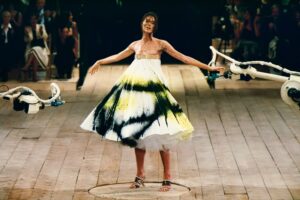
One of the most memorable examples was the Spring/Summer 1999 show, where model Shalom Harlow stood on a rotating platform while robotic spray guns painted her white dress.
The performance blurred the boundaries between fashion, technology, performance art, and theatre.
Another unforgettable presentation was Voss, his Spring/Summer 2001 collection. The runway was designed to resemble a psychiatric hospital, with models appearing inside a mirrored glass box.
At the end of the presentation, the central structure opened to reveal a figure surrounded by moths.
Such presentations transformed the fashion show into a narrative experience and demonstrated McQueen’s belief that fashion could communicate emotions and ideas beyond the clothing itself.
Technology and Innovation
McQueen was not afraid of technology.
He used digital imagery, robotics, unconventional materials, dramatic lighting, and complex staging to create immersive experiences.
The Plato’s Atlantis collection for Spring/Summer 2010 became particularly famous for its futuristic aesthetic. The collection explored evolution, technology, and the relationship between humans and nature.
The models wore sculptural garments and distinctive digitally printed designs, while the runway presentation was streamed online.
The collection also introduced the world to the now-iconic Armadillo boots, which created an elongated, almost alien silhouette.
Plato’s Atlantis demonstrated McQueen’s ability to combine fashion with ideas about humanity’s future.
Celebrity Influence
McQueen’s designs attracted many influential celebrities and artists.
His dramatic creations became popular among musicians and performers who wanted fashion that expressed individuality.
Lady Gaga was one of the celebrities strongly associated with McQueen’s work. She famously wore his designs in her music video for “Bad Romance”, helping introduce his aesthetic to an even wider global audience.
The relationship between McQueen’s fashion and popular culture became particularly significant during the final years of his career.
His designs were not merely clothing; they became visual symbols of identity, performance, and artistic expression.
The Iconic Skull Motif
One of McQueen’s most recognizable symbols is the skull.
The skull appeared across scarves, accessories, prints, and other products associated with the brand.
Its popularity transformed the motif into an important part of the brand’s visual identity.
The skull reflected several of McQueen’s recurring themes: mortality, darkness, rebellion, and beauty. Yet it also became a commercial symbol that helped the house reach consumers beyond the runway.
The skull scarf, in particular, became a recognizable fashion accessory and helped establish McQueen’s brand presence in luxury accessories.
Personal Struggles and Creative Pressure
Behind McQueen’s extraordinary success was a deeply complex personal life.
He experienced significant emotional struggles throughout his career. The death of his close friend and supporter Isabella Blow in 2007 had a profound impact on him.
Blow had played a crucial role in his early career, and her loss deeply affected him personally and creatively.
McQueen also experienced the pressures associated with maintaining a major international fashion business while continuing to produce ambitious collections.
Despite his success, his work frequently explored themes of vulnerability, mortality, isolation, and transformation.
These themes were not simply aesthetic choices. They often reflected deeper emotional experiences.
Final Years and Legacy
Alexander McQueen died on February 11, 2010, at the age of 40.
His death shocked the fashion world and led to an enormous outpouring of grief from designers, celebrities, models, and admirers around the world.
His final collections demonstrated that his creativity remained extraordinarily powerful until the end of his career.
The Fall/Winter 2010 collection, completed after his death by his studio team under the direction of Sarah Burton, reflected his fascination with history, religion, and craftsmanship.
The collection became part of the emotional legacy surrounding his career.
Sarah Burton and the Continuation of the House
After McQueen’s death, Sarah Burton became the creative director of the Alexander McQueen house.
Burton had worked alongside McQueen for many years and understood the technical and creative foundations of the brand.
Under her leadership, the house developed a more refined interpretation of McQueen’s legacy while maintaining its emphasis on craftsmanship, tailoring, and dramatic design.
One of Burton’s most famous moments came when she designed the wedding dress worn by Catherine, Princess of Wales, for her 2011 wedding to Prince William.
The dress combined traditional British craftsmanship with modern elegance and became one of the most discussed royal wedding dresses of the modern era.
It also demonstrated how McQueen’s fashion house could evolve while maintaining its connection to British heritage.
Alexander McQueen’s Influence on Modern Fashion
McQueen’s influence extends far beyond the designs he personally created.
He changed how designers approached runway shows. Instead of treating a fashion show simply as a commercial presentation, he demonstrated that it could function as theatre, performance art, film, and storytelling.
He also challenged the idea that fashion needed to be traditionally beautiful.
For McQueen, fashion could be uncomfortable, disturbing, emotional, political, romantic, or even frightening.
His work encouraged designers to experiment with narrative and emotion.
His influence can be seen in contemporary designers who use dramatic runway presentations, unconventional materials, sculptural silhouettes, historical references, and conceptual storytelling.
Craftsmanship and British Identity
Although McQueen became a global fashion icon, British identity remained an important part of his work.
His Savile Row training influenced his approach to tailoring, while his interest in British history repeatedly appeared in his collections.
He was able to combine the discipline of traditional British tailoring with the imagination of contemporary art.
This balance became one of the reasons his work felt simultaneously classic and revolutionary.
The Alexander McQueen Brand Today
Today, the Alexander McQueen house remains an important name in international luxury fashion.
The brand continues to produce ready-to-wear collections, accessories, footwear, handbags, and other luxury products.
The house’s identity continues to be associated with strong tailoring, craftsmanship, dramatic silhouettes, and a distinctive approach to British fashion.
McQueen’s original vision remains an important reference point, even as successive creative directors interpret the brand in new ways.
Conclusion
Alexander McQueen was much more than a fashion designer. He was a storyteller, craftsman, artist, and provocateur who believed clothing could communicate powerful emotions and ideas.
His career lasted less than two decades, but his influence was enormous. From his early work on Savile Row to his groundbreaking runway presentations and international success, McQueen constantly challenged expectations.
He demonstrated that fashion could be simultaneously beautiful and disturbing, traditional and revolutionary, luxurious and rebellious.
His designs explored life, death, history, nature, sexuality, identity, and transformation. His runway shows turned fashion into unforgettable theatre, while his tailoring demonstrated an extraordinary mastery of craftsmanship.
Perhaps the most important part of McQueen’s legacy is his refusal to create fashion simply for the sake of fashion. He wanted his work to make people feel something.
That emotional power is why his designs continue to inspire audiences years after his death.
Alexander McQueen once described fashion as a way of expressing individuality and identity. His own career embodied that philosophy. He created a world where clothing could become art, a runway could become theatre, and a designer could challenge an entire industry.
His legacy continues not because he followed fashion’s rules, but because he had the courage to break them.